
Embodied Carbon Management
Embodied carbon Management in Construction
Your Carbon Report Is Based on Averages.Your Targets Are Not.

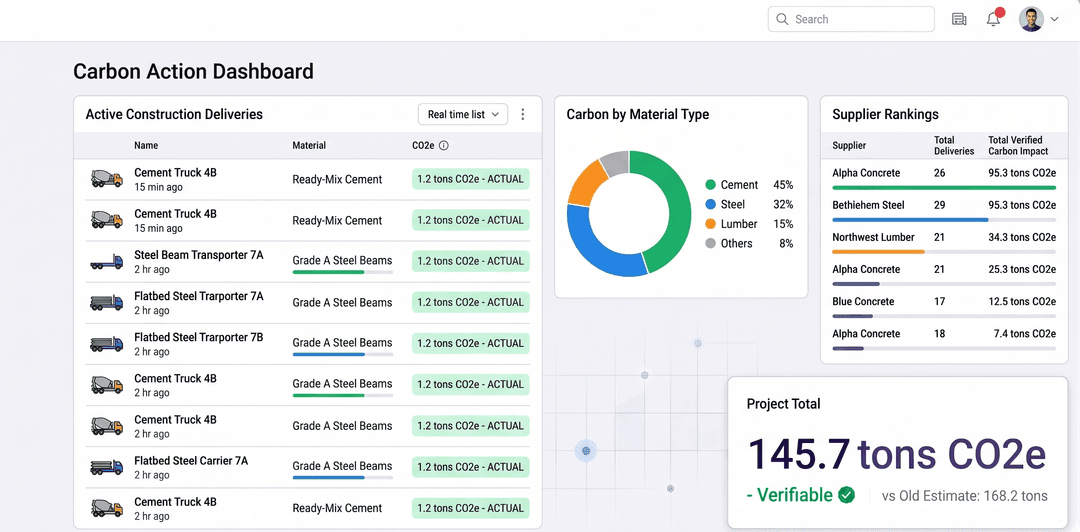
IntelliByld replaces carbon estimates with real measurements — logged per delivery, updated in real time, reported automatically.
Most construction projects calculate embodied carbon using industry average factors — not actual delivery data. The result is a sustainability report that satisfies compliance requirements but tells you nothing about where carbon is actually being generated, or where it can be reduced. IntelliByld tracks every material movement against its real carbon footprint, so your ESG data reflects what is happening on site — not what a spreadsheet assumes.

  • Carbon calculated from averages — not real deliveries.
  • Sustainability data arrives too late to change anything.
  • No visibility into which suppliers drive the most carbon.
  • Green Mark compliance starts at handover — not day one.
image
How IntelliByld Coordinates Across Sites
One view. Every site.
No blind spots.
1
Monitors — Material flows, every site
  • Live carbon data per delivery
  • EPDs pulled from supplier records
  • No manual kgCO₂e entry
2
Detects — Where carbon accumulates
  • High-impact materials flagged early
  • Hotspots across structure, envelope, MEP
  • Targets vs actuals, in real time
3
Consolidates — Portfolio carbon view
  • Whole-life carbon, all projects
  • Low-carbon swaps surfaced by volume
  • Benchmarks drawn from live data
4
Briefs — RIBA Stage 5 ready
  • GLA, BREEAM, LETI aligned reports
  • One export, not four spreadsheets
  • Audit trail from pour to sign-off
Why IntelliByld
The difference, side by side
Without IntelliByldWith IntelliByld
Carbon data captureManual entry per materialAutomatic from every delivery
EPD sourcingChased from suppliers manuallyPulled and matched in real time
Hotspot detectionFound in post-project reviewFlagged before pour
Portfolio carbon viewOne spreadsheet per siteAll projects, one live dashboard
Compliance reportingAssembled at handoverGLA, BREEAM, LETI ready always
FAQs
Frequently Asked questions

Embodied carbon shouldn't be a spreadsheet exercise at Stage 5. Here's how IntelliByld pulls live carbon data from every delivery, flags hotspots early, and produces GLA / BREEAM / LETI-aligned reports without manual kgCO₂e entry.

Learn More

How does IntelliByld measure embodied carbon per delivery instead of using industry averages?

Most projects calculate embodied carbon by multiplying material quantities by generic factors from industry databases — averages that don't reflect which supplier produced the material, how it was manufactured, or how far it travelled. IntelliByld captures the actual delivery: the specific supplier, the EPD attached to that batch, the transport mode, and the route. Carbon is then logged per delivery rather than estimated per quantity, so the project's reported footprint reflects what was actually built into the structure, not what a spreadsheet assumed.

What is an EPD and how does IntelliByld source them automatically?

An EPD (Environmental Product Declaration) is a verified document published by a manufacturer that quantifies the environmental impact of a specific product — including embodied carbon per unit. Traditionally, sustainability consultants chase EPDs from suppliers manually at project closeout, often months after the material was poured. IntelliByld pulls EPDs from supplier records as deliveries are confirmed, matches them to the right line item in the Digital Twin, and flags any material that arrives without one. No manual kgCO₂e entry, no Stage 5 reconciliation.

Which carbon reporting frameworks does IntelliByld support?

IntelliByld produces reports aligned to the GLA (Greater London Authority) Whole Life-Cycle Carbon Assessment guidance, BREEAM, and LETI (London Energy Transformation Initiative) targets. Because the underlying carbon data is captured per delivery from day one, the same dataset can be exported to whichever framework a project, lender, or planning authority requires — without rebuilding the assessment for each one. The platform is designed so that adding additional frameworks (such as Singapore Green Mark or RICS Whole Life Carbon Assessment) does not require recapturing data.

Can IntelliByld track embodied carbon across a portfolio, not just a single project?

Yes. The platform consolidates carbon data across every project a contractor or developer is delivering, producing a portfolio-level whole-life carbon view. Low-carbon supplier swaps that work on one project become visible as opportunities across others with similar specifications. Benchmarks are drawn from the organisation's own live data rather than external averages, so portfolio targets reflect what is achievable with the supply chain actually being used. This is particularly relevant for developers and Tier-1 contractors with science-based carbon reduction commitments.